


Five-Speed Automatic Transmission
The shift lever position display (located in the instrument panel cluster) indicates the transmission gear range. You must press the brake pedal to move the shift lever out of the PARK position (refer to “Brake/Transmission Shift Interlock System” in this section). To drive, move the shift lever from PARK or NEUTRAL to the DRIVE position.
The electronically-controlled transmission provides a precise shift schedule. The transmission electronics are self-calibrating; therefore, the first few shifts on a new vehicle may be somewhat abrupt. This is a normal condition, and precision shifts will develop within a few hundred miles (kilometers).
Shifting from DRIVE to PARK or REVERSE should be done only after the accelerator pedal is released and the vehicle is stopped. Be sure to keep your foot on the brake pedal when moving the shift lever between these gears.
The transmission shift lever has only PARK, REVERSE, NEUTRAL, and DRIVE shift positions. Manual downshifts can be made using the Electronic Range Select (ERS) shift control (refer to “Electronic Range Select (ERS)” in this section). Moving the shift lever to the left or right (-/+) while in the DRIVE position will select the highest available transmission gear, and will display that gear in the instrument cluster as 4, 3, 2, 1.
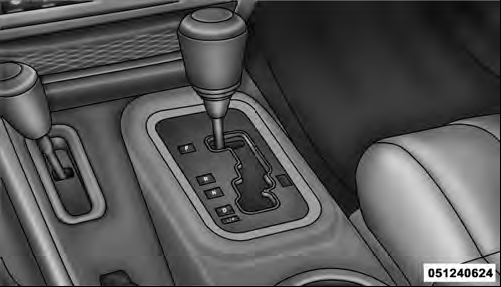
Shift Lever
See also:
Tire Spinning
When stuck in mud, sand, snow, or ice conditions, do not
spin your vehicle’s wheels above 30 mph (48 km/h).
WARNING!
Fast spinning tires can be dangerous. Forces generated
by excessive wheel ...
Trailer Tongue Weight (TW)
The trailer tongue weight is the downward force exerted on the hitch ball by
the trailer. In most cases it should not be less than 10% or more than 15% of the
trailer load. You must consider this ...
Tires
Examine tires for excessive tread wear and uneven wear patterns. Check for stones,
nails, glass, or other objects lodged in the tread or sidewall. Inspect the tread
for cuts and cracks. Inspect si ...