


Trailer And Tongue Weight
Always load a trailer with 60% to 65% of the weight in the front of the trailer. This places 10% to 15% of the Gross Trailer Weight (GTW) on the tow hitch of your vehicle. Loads balanced over the wheels or heavier in the rear can cause the trailer to sway severely side-to-side which will cause loss of control of vehicle and trailer.
Failure to load trailers heavier in front is the cause of many trailer collisions.
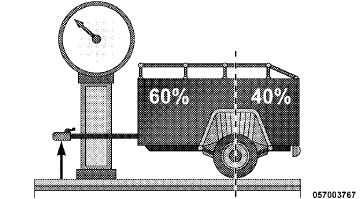
Consider the following items when computing the weight on the rear axle of the vehicle:
• The trailer tongue weight.
• The weight of any other type of cargo or equipment put in or on your vehicle.
• The weight of the driver and all passengers.
NOTE: Remember that everything put into or on the trailer adds to the load on your vehicle. Also, additional factory-installed options, or authorized dealer-installed options, must be considered as part of the total load on your vehicle. Refer to the “Tire Safety Information/Tire and Loading Information Placard” in “Starting and Operating” for the maximum combined weight of occupants and cargo for your vehicle.
See also:
Memory Position Recall
NOTE: The vehicle must be in PARK to recall memory
positions. If a recall is attempted when the vehicle is not
in PARK, a message will be displayed in the Electronic
Vehicle Information Center ( ...
Station List Menu
Channel Selection Menu For SIRIUS Backseat TV™
When listening to Satellite audio, pressing the remote
control’s MENU button displays a list of all available
channels. Navigate this list usi ...
Description
The Quadra-Lift™ air suspension system provides full
time load leveling capability along with the benefit of
being able to adjust vehicle height by the push of a
button.
Selec-Terrain™ Sw ...